Besakih Mother Temple, also known as Pura Besakih, is Bali’s largest and most important Hindu temple complex. Located on the slopes of Mount Agung in Karangasem, it is widely known as the Mother Temple of Bali and remains an active place of worship.
Before you visit, it helps to understand what makes Besakih significant and what to expect from the complex. This guide covers the essential context and highlights to help you plan a more meaningful visit.
Why Besakih Is Called the Mother Temple of Bali
Besakih is known as the Mother Temple of Bali because of its central spiritual role within Balinese Hinduism. It is not a single temple building, but a large complex used for worship, pilgrimage, and important religious ceremonies.
Its importance comes from several factors:
- Central religious role: Besakih is widely regarded as the main temple complex of Balinese Hinduism.
- Ancient history: The site has been revered for centuries, with historical references dating back to around 1007 AD.
- Sacred location: Besakih sits on the slopes of Mount Agung, Bali’s highest and most sacred mountain.
- Large temple complex: The site includes numerous temples and shrines arranged across rising terraces.
- Active place of worship: Balinese Hindus still visit Besakih for daily prayers, pilgrimages, and major ceremonies.
At the center of the complex is Pura Penataran Agung, the principal temple at Besakih. However, the wider site extends far beyond this main area. Its temples are positioned across the mountain slopes, creating a layered layout that feels very different from the smaller, standalone temples found elsewhere in Bali.
The connection with Mount Agung is also an important part of Besakih’s identity. The mountain provides more than a dramatic backdrop; it forms part of the sacred landscape that gives the temple complex its spiritual significance.
This relationship reflects the Balinese Hindu principle of Tri Hita Karana, which emphasizes harmony between:
- people and the divine;
- people and one another; and
- people and the natural environment.
Because Besakih remains an active religious site, your experience may vary depending on the ceremonial calendar. During major ceremonies, you may encounter:
- larger crowds of worshippers;
- temporary access restrictions;
- decorated temple courtyards;
- religious processions; and
- a more intense, authentic atmosphere.
For this reason, Besakih should be approached as a living place of worship rather than simply a sightseeing attraction. Its scale, history, connection with Mount Agung, and continuing religious role are what make it the Mother Temple of Bali.
What to See at Besakih Temple
Once you understand that Besakih is a large temple complex rather than a single monument, the site becomes much easier to appreciate. Instead of trying to see every shrine, focus on the main architectural, cultural, and landscape elements that give Besakih its distinctive character.
1. Pura Penataran Agung
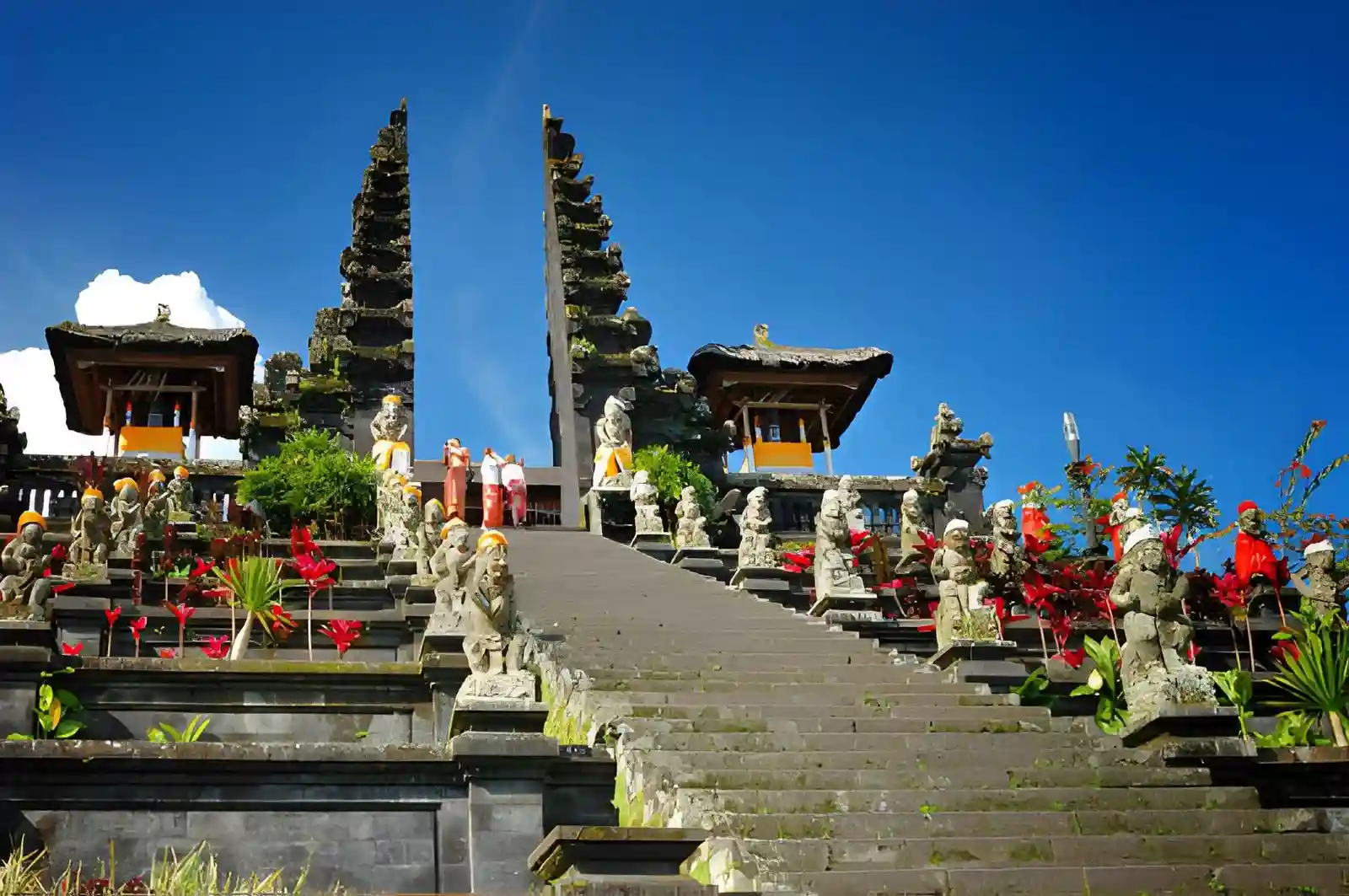
Start with Pura Penataran Agung, the main temple and central area of the Besakih complex. Its prominent stairway, gateways, courtyards, shrines, and multi-tiered meru structures make it one of the most recognizable parts of the site.
This is also where the scale of Besakih becomes clear. The temple is not designed as a simple tourist attraction with one building to photograph; its courtyards and religious structures form part of a larger ceremonial environment. Take time to observe the arrangement of the buildings rather than focusing only on the main entrance.
2. Meru Towers and Traditional Balinese Architecture
The meru, or tiered-roof shrines, are among the architectural details worth paying attention to. Their distinctive stacked roofs create some of the most recognizable visual features of Balinese temples, while the surrounding gates, stone carvings, walls, and courtyards add layers of detail.
At Besakih, these elements are particularly impressive because they appear across a much larger religious complex. Looking beyond the main gate gives you a better sense of how traditional Balinese temple architecture works as a complete environment rather than as isolated decorative structures.
3. The Wider Temple Complex
Besakih consists of numerous temples and shrines arranged across several terraces. The official tourism authority describes the complex as comprising 22 temples across six rising terraces, with Pura Penataran Agung serving as the central temple.
You do not need to treat the visit like a checklist of every temple. Instead, pay attention to how the different structures are positioned across the slopes and how the complex gradually rises toward Mount Agung. That layout is part of what makes Besakih different from smaller temple visits around Bali.
4. Mount Agung and the Surrounding Landscape
The mountain setting is another major part of the Besakih experience. From the complex, you can appreciate the elevated landscape around Mount Agung, with greenery, villages, and agricultural areas extending across the surrounding region.
Clear weather can make the mountain backdrop particularly striking, while clouds and mist can change the atmosphere completely. This also makes Besakih interesting for photography: you are not only photographing temple architecture, but the relationship between the structures, mountain slopes, and wider East Bali landscape.
The best experience comes from looking at all three elements together, the religious complex, the architecture, and the sacred mountain landscape, rather than treating Besakih as simply another temple photo stop.
You may also want to read this: 15 Best Temples in Bali for Your Must-Visit Island Itinerary
Besakih Temple Entrance Fee, Opening Hours & What to Expect
Now that you know why Besakih is called Bali’s Mother Temple and what you can see inside the complex, the next step is planning the visit itself.
The entrance cost, opening hours, and amount of time you need can make a noticeable difference to your day, especially if you’re combining Besakih with other East Bali destinations.
Entrance Fee
Besakih charges an entrance fee, but check the latest rate before your visit because published prices can change and official tourism sources currently show different figures.
The latest official Indonesia Travel information currently lists:
- Estimated entrance range: IDR 60,000–100,000 on one official guide
- International visitor rate: IDR 150,000 on another official Indonesia Travel page
- Sarong and sash: Included according to the official guide
- Local guide: Around IDR 50,000–100,000 according to the same guide
Because these official pages currently show different rates, we recommend checking the latest information through the official destination or ticketing channel before you go rather than relying on an older travel article.
Also keep in mind that your total Besakih budget may include more than the entrance ticket:
- Transportation
- Parking, where applicable
- Optional local guide
- Food and drinks
- Donations or other voluntary expenses
Tip: Don’t choose a tour or transport option based only on the entrance fee. For Besakih, transportation and the amount of time you spend on the road can have a much bigger impact on your overall day.
Opening Hours
Besakih is generally open to visitors daily from around 8:00 AM to 5:00 PM WITA, according to Indonesia’s official tourism information.
However, remember that Besakih is an active place of worship, so normal visitor hours don’t mean every area will always be accessible.
Ceremonies can affect:
- Access to certain temple areas
- Visitor movement
- Crowd levels
- Parking and traffic
- The amount of time you need
For a straightforward sightseeing experience, morning is usually the better choice. You get cooler walking conditions and more time to explore before the day becomes busier.
How Long Do You Need?
For most first-time visits, 1.5–2 hours is a practical starting point.
That gives you enough time to:
- Explore Pura Penataran Agung
- See the main temple structures
- Appreciate the meru and traditional architecture
- Walk through the main visitor areas
- Enjoy the Mount Agung surroundings
- Take photographs
Allow 2–3 hours or longer if you want a slower experience or plan to explore more of the complex.
You may need additional time if:
- You’re visiting during a ceremony
- You want to photograph the temple extensively
- You’re travelling with children or older family members
- You’re visiting with a local guide
- Weather slows down your walking
- You want to spend more time taking in the mountain scenery
In other words, don’t schedule Besakih as a rushed 30-minute photo stop. The complex covers a large area, and part of its appeal comes from seeing how the temples, terraces, architecture, and Mount Agung landscape work together.
What to Wear & Besakih Temple Etiquette
Because you’ve already seen that Besakih is an active religious complex, the same principle applies when you arrive: dress and behave as you would when entering an important place of worship.
What Should You Wear?
Wear clothing that is respectful and comfortable for walking. Bring or wear:
- Sarong
- Sash
- Clothing that covers your shoulders
- Clothing that covers your knees
- Comfortable walking shoes
- A light layer if you’re sensitive to cooler mountain weather
A sarong and sash are required for entering the temple area, and official tourism guidance states that these can be rented at the entrance if you don’t bring your own.
Comfortable footwear is particularly useful because Besakih is spread across multiple levels and terraces. You may be walking and using stairs more than you would at a smaller temple.
Temple Etiquette to Follow
A few simple rules will make your visit more respectful and straightforward:
- Wear a sarong and sash as required.
- Stay within areas open to visitors.
- Do not enter restricted or sacred areas.
- Avoid disturbing people who are praying.
- Keep your voice low around active ceremonies.
- Ask before photographing people involved in religious activities.
- Follow instructions from temple staff or local guides.
Indonesia’s official tourism guidance specifically advises visitors to respect worshippers, avoid restricted sacred areas, and maintain a quiet atmosphere inside the temple.
This becomes particularly important during major ceremonies. Besakih hosts numerous religious events throughout the year, and some ceremonies can bring large numbers of worshippers to the complex.
The annual Ida Bhatara Turun Kabeh, for example, is held around the Balinese month of Kedasa, generally falling around March or April, and can attract thousands of devotees.
What If You Visit During a Ceremony?
This can actually be one of the most interesting times to experience Besakih, but it also requires more flexibility.
During major ceremonies, you may encounter:
- Larger crowds
- Increased religious activity
- Decorated temple areas
- Temporary access restrictions
- More traffic around the destination
Besakih hosts numerous religious ceremonies throughout the year. The annual Ida Bhatara Turun Kabeh, held around the Balinese month of Kedasa, is one of its major ceremonies and can attract large numbers of worshippers.
If you’re visiting during a ceremony, don’t expect the same sightseeing experience described in a standard itinerary. Instead, allow extra time and follow instructions from temple staff or local guides.
Best Time to Visit Besakih Temple
For most people, the best combination is a weekday morning during Bali’s drier months, especially if you want easier walking conditions, a calmer visit, and a better chance of seeing the surrounding mountain landscape.
But there are several factors worth considering.
Best Time of Day
Morning is the strongest choice because:
- Temperatures are generally more comfortable
- You have more time to explore
- The temple can feel calmer before later-day activity
- Morning light works well for photography
- You have flexibility to continue to another destination afterward
An early start is particularly useful if Besakih is part of a larger East Bali route.
Best Months
The dry season, roughly April to October, is generally a practical period for visiting Bali’s outdoor attractions.
For Besakih, however, don’t assume dry season means guaranteed clear Mount Agung views. The temple sits high on the mountain slopes, and cloud conditions can change throughout the day.
For the best chance of clearer scenery:
- Start early
- Check the weather forecast
- Avoid planning your entire experience around one mountain photo
- Keep some flexibility in your itinerary
Weekday or Weekend?
If you have the choice, a weekday morning is generally preferable when your priority is a more relaxed sightseeing experience.
A weekday can make it easier to:
- Walk around without as much congestion
- Spend longer at the main temple areas
- Take photographs
- Combine Besakih with another destination
- Avoid some weekend activity
However, the religious calendar matters more than simply choosing a weekday. A major ceremony can make Besakih significantly busier regardless of the day of the week.
For more cultural experiences in bali, explore our related guides below.
- Penglipuran Village Festival 2026: Dates, Schedule & What to Expect
- Tirta Empul Temple: Bali’s Sacred Holy Spring and What to Know Before You Visit
- Ulun Danu Beratan Temple: Complete Guide to Bali’s Floating Lake Temple
Final Thoughts: Is Besakih Worth Adding to Your Bali Itinerary?
Yes. Besakih is worth adding to your Bali itinerary if you want to experience Bali beyond beaches and photo spots. Its importance comes from the combination of cultural significance, impressive scale, active Hindu worship, and its setting on the slopes of Mount Agung.
What makes the visit particularly worthwhile is that you are not simply looking at one historic building. Besakih is a living temple complex where architecture, religious traditions, and the surrounding highland landscape come together.
Before you go, keep the practical side in mind:
- Allow enough time to explore without rushing.
- Dress respectfully with a sarong and sash.
- Expect some walking and stairs across the temple complex.
- Check the latest entrance information before your visit.
- Be flexible during ceremonies, when access and crowd levels can change.
- Visit in the morning if you want cooler conditions and more time for sightseeing.
If you’re planning an East Bali route, Besakih also works well as part of a wider day rather than as an isolated stop. Bali Island Vacations can help arrange a private East Bali itinerary combining Besakih with destinations such as Sidemen, Kintamani, or Tirta Gangga based on your available time and travel style.
Frequently Asked Questions About Besakih Mother Temple
What is Besakih Mother Temple famous for?
Besakih is famous as Bali’s largest and most important Hindu temple complex. It is located on the slopes of Mount Agung and consists of numerous temples and shrines, with Pura Penataran Agung serving as its central temple.
Why is Besakih called the Mother Temple of Bali?
Besakih is called the Mother Temple because of its central spiritual importance within Balinese Hinduism. It is a major place of worship and pilgrimage and remains an active religious complex.
Is Besakih Temple worth visiting?
Yes, especially if you’re interested in Balinese culture, Hindu temples, traditional architecture, and mountain scenery. Its large scale also makes the experience different from visiting a smaller temple in Bali.
How much does it cost to visit Besakih Temple?
Entrance fees can change, and official tourism sources currently publish different rates. Check the latest official information before your visit rather than relying on an older price listed online.
What should I wear to Besakih Temple?
Wear respectful clothing that covers your shoulders and knees. A sarong and sash are required for entering the temple area and can be rented if needed.
Can tourists enter Besakih Temple?
Yes. Besakih welcomes visitors, but it remains an active place of worship. Some areas may be restricted, particularly during religious ceremonies, so always follow local instructions.
Do you need a guide at Besakih Temple?
A guide is not essential for simply visiting the main areas, but a local guide can make the experience easier to understand because Besakih is a large and culturally complex temple site.
How long should you spend at Besakih Temple?
Plan for around 1.5–2 hours for a standard visit. Allow longer if you want to explore more of the complex, take photographs, visit during a ceremony, or enjoy a slower cultural experience.
What is the best time to visit Besakih Temple?
Morning is generally the best time, particularly on a regular weekday. It offers cooler conditions for walking and gives you more time to explore before continuing to other East Bali destinations.
Can you visit Besakih during a ceremony?
Yes, but the experience can be very different. Ceremonies may bring larger crowds and temporary access restrictions. If you visit during one, treat the temple as an active place of worship and follow local instructions.
How far is Besakih Temple from Ubud?
Besakih is in Karangasem, East Bali, so the journey from Ubud can take a significant part of the day depending on traffic and your exact starting point. It is more practical to combine Besakih with nearby East Bali destinations rather than planning several long cross-island journeys.
What can you visit near Besakih Temple?
Besakih can be combined with destinations such as Sidemen, Kintamani, and Tirta Gangga, depending on your route and available time. Choosing destinations that follow a logical route can make the day much more comfortable.