
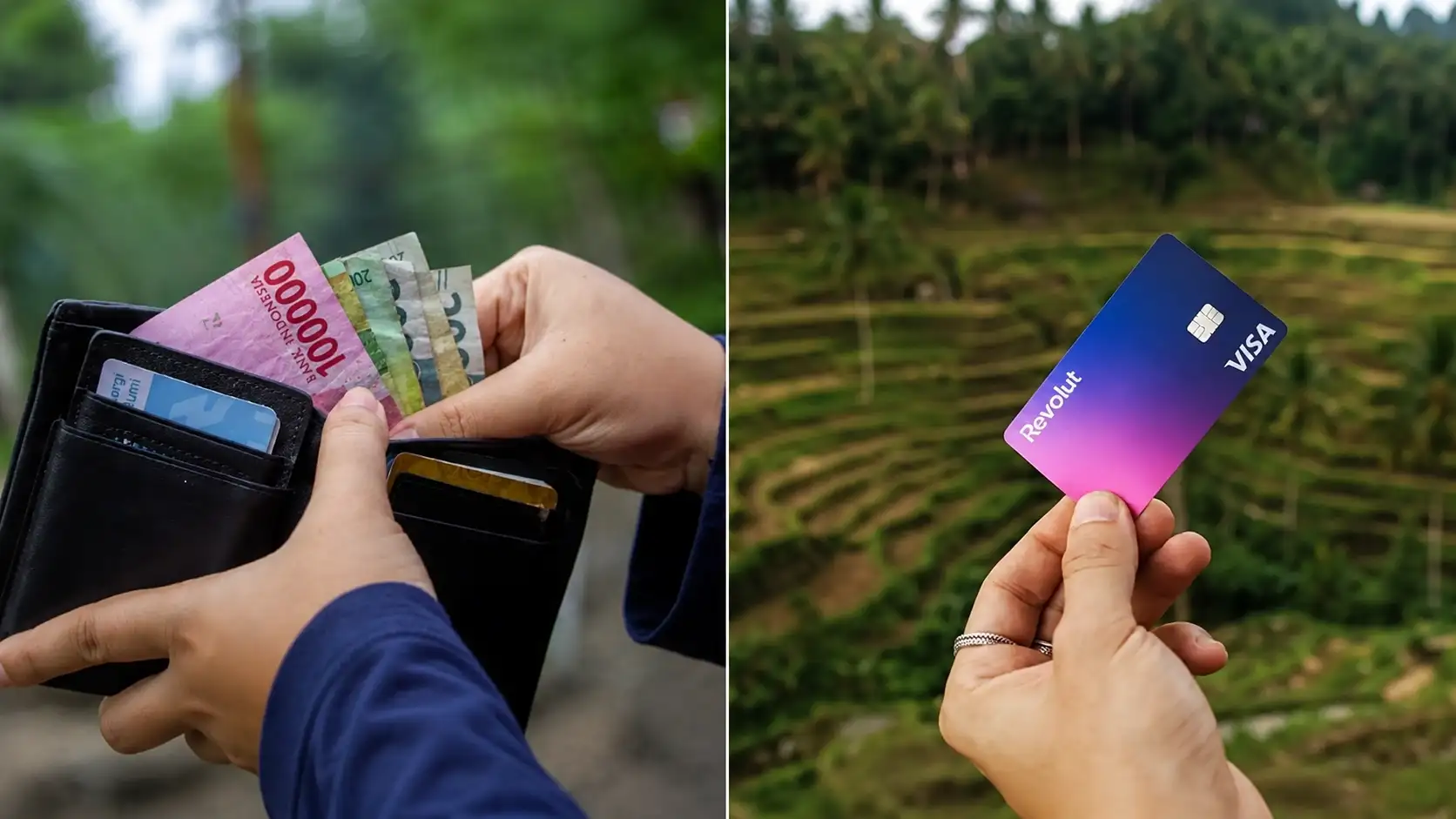
Bali is increasingly easy to navigate with a card, especially if you’re staying at hotels, resorts, established restaurants, cafés, beach clubs, and other businesses in popular tourist areas. But cash is still important for smaller local businesses, markets, warungs, and everyday purchases where card payments may not be available.
The easiest approach is not to choose between cash or card, but to use both. Keep some Indonesian rupiah (IDR) with you for smaller payments and local businesses, while using your debit or credit card for larger purchases where card payments are accepted. Digital payments are also becoming more common, including QRIS Cross-Border for tourists using participating payment apps from supported countries.
If you’re wondering whether you should rely on cash, cards, or digital payments during your Bali holiday, here’s how each option works in practice.
Do You Need Cash or a Card in Bali?
You should bring both cash and a card to Bali. Cards are convenient for larger expenses and established businesses, while Indonesian rupiah remains the safer option for smaller local transactions and places that do not accept cards.
Quick Overview
| Payment Method | Best Used For |
|---|---|
| Cash (IDR) | Warungs, markets, small vendors, tips, small purchases |
| Debit/Credit Card | Hotels, resorts, restaurants, cafés, larger businesses |
| QRIS | Participating merchants if your payment app supports QRIS Cross-Border |
| ATM | Getting Indonesian rupiah when you need more cash |
The practical difference becomes clearer once you move between Bali’s more developed tourist areas and smaller local businesses. A hotel in Seminyak may accept your card without any issue, while a small warung or market stall may expect payment in cash.
QRIS adds another option, but it shouldn’t be treated as a universal replacement for cash or cards. Bank Indonesia’s QRIS Cross-Border system allows international tourists from participating partner countries to pay at QRIS merchants using supported payment applications.
As of 2026, the system includes connections with countries such as Thailand, Malaysia, Singapore, Japan, South Korea, and China, although the exact payment app available to you depends on your country and provider.
For most trips, the simplest strategy is:
- Keep some IDR cash for everyday spending.
- Carry at least one Visa or Mastercard as your main card.
- Have a second card or backup payment method in case your primary card doesn’t work.
- Use QRIS Cross-Border if your payment provider supports it.
- Don’t carry your entire holiday budget as cash.
This gives you flexibility without making your trip unnecessarily complicated.
Where Can You Pay by Card in Bali?
Card payments are most convenient in Bali’s established tourism businesses. Visa and Mastercard are widely useful, particularly in areas with a strong international tourism market, although acceptance still varies from one business to another.
1. Hotels & Resorts
Hotels and resorts are among the easiest places to use a card.
You can generally expect card payment options for:
- Room payments
- Restaurant bills
- Spa treatments
- Resort activities
- Deposits or incidental charges
If you’re staying at an international or established local hotel, carrying a large amount of cash for your accommodation usually isn’t necessary.
However, check the payment terminal or hotel invoice before completing a transaction if you’re unsure about additional card charges.
2. Restaurants & Cafés
Established restaurants and cafés in areas such as Seminyak, Canggu, Ubud, Sanur, and other major tourism hubs commonly offer card payment. The situation changes at smaller local eateries.
A simple rule works well:
- International-style restaurant → card is usually convenient.
- Small local warung → carry cash.
That distinction can save you from reaching the counter only to discover that your preferred payment method isn’t available.
3. Beach Clubs & Bars
Bali’s established beach clubs and upscale bars are generally well equipped for card payments. Card payment is particularly convenient when you’re paying for:
- Food and drinks
- Table service
- Minimum-spend requirements
- Larger group bills
For these venues, your card can be much easier than carrying a large amount of cash. Still, check the venue’s payment terms before ordering if you’re concerned about minimum spending or additional charges.
4. Supermarkets & Established Shops
Larger supermarkets, shopping malls, and established retailers generally provide card payment options.
This makes a card useful for larger purchases such as:
- Groceries
- Clothing
- Travel essentials
- Souvenirs
- Personal items
For small independent shops, however, cash remains a useful backup.
5. Tours & Activities
Many established tour operators accept cards, particularly when you book in advance or pay through an online booking system.
This is useful for larger expenses such as:
- Private tours
- Day trips
- Diving experiences
- Island excursions
- Activity packages
But don’t assume every payment connected to a tour will be cashless. Small entrance fees, local purchases, parking, tips, or payments to individual vendors can still require IDR.
6. The Simple Rule to Remember
Use your card where the business is set up for international payments. Keep cash ready everywhere else.
That approach gives you the convenience of card payments without relying on them in situations where cash is still the more practical option.
Read also: 6 Luxury Things to Do in Bali for a Calm and Elevated Escape
Where Do You Still Need Cash in Bali?
Even though cards are widely accepted across Bali’s major tourist areas, cash is still useful for everyday situations where payment infrastructure is more limited. Indonesia’s official tourism guidance specifically recommends carrying rupiah when visiting local or traditional markets and more remote areas.
You are most likely to need cash for:
1. Local Warungs
Small family-run warungs may accept cash even when larger restaurants nearby accept cards.
If you’re eating at a simple local restaurant, buying a drink from a roadside stall, or stopping for food away from the main tourist areas, having some IDR in your wallet makes payment much easier.
2. Traditional Markets
Cash is particularly useful at traditional markets and small souvenir stalls.
Markets can involve many small purchases, and not every individual seller will have card facilities. Keeping smaller rupiah denominations also makes these transactions more convenient.
3. Small Vendors & Street Food
Street food, drinks, snacks, parking, and other small purchases are good reasons to keep some cash available.
You don’t need to carry a large amount. A small daily cash allowance is usually more practical than taking your entire holiday budget with you.
4. Smaller Entrance Fees & Local Payments
Some local attractions, parking areas, or small community-run activities may still require cash.
This becomes more relevant when you leave the main tourist hubs and visit rural areas, waterfalls, villages, or smaller attractions.
5. Tips & Small Purchases
Cash is also useful when you want to leave a small tip or pay for inexpensive services where card payments aren’t practical.
The rule is simple: use your card for convenience, but keep IDR cash for the places where technology isn’t part of the transaction.
Read also: Bali Travel Cost Breakdown in 2026: What You Actually Spend
ATMs in Bali: How to Get Cash Safely
ATMs are widely available in Bali’s major tourist destinations, and international networks such as Visa/Plus and Mastercard/Cirrus are commonly supported by Indonesian bank ATMs.
Indonesia Travel recommends checking that your card’s compatible network logo appears on the ATM before inserting your card.
For the safest and simplest experience, prioritize ATMs operated by established Indonesian banks rather than relying on unfamiliar standalone machines.
Use Bank-Operated ATMs
Look for ATMs connected to recognizable Indonesian banks, particularly when you’re withdrawing a larger amount.
Before inserting your card, check:
- Your card network is supported
- The ATM is physically intact
- There are no suspicious devices around the card slot or keypad
- The transaction screen looks normal
- The machine is located somewhere reasonably secure
Bank Indonesia also advises users to inspect ATMs for suspicious devices such as skimmers or hidden cameras and to contact the card issuer immediately if a card becomes stuck in the machine.
Withdraw Enough for Your Needs
If you’re heading to a more remote part of Bali, it’s sensible to withdraw some IDR beforehand rather than waiting until you need cash.
This is particularly useful if your itinerary includes rural villages, traditional markets, waterfalls, or other destinations away from major tourist centers. Indonesia Travel similarly recommends withdrawing cash in major cities before traveling to more secluded destinations.
At the same time, don’t withdraw your entire holiday budget at once. Carrying excessive cash creates unnecessary risk and removes one of the advantages of having a card.
Keep Some Smaller Notes
ATMs commonly dispense IDR50,000 and IDR100,000 notes. Larger denominations are convenient for bigger purchases but can be harder to use for very small transactions in rural or local settings.
So if you withdraw cash, keep some smaller notes available rather than putting every banknote into one wallet compartment.
Read also: 10 Bali Scams to Avoid: Stay Safe & Travel With Confidence
Bali ATM Fees: What Should You Watch For?
This is where your payment strategy can make a real difference. When you withdraw Indonesian rupiah using a foreign card, there can be more than one layer of cost:
- The Indonesian ATM operator’s fee, if applicable
- Your own bank’s international ATM fee
- Foreign-exchange or currency conversion costs from your card issuer
These fees don’t necessarily come from the same company, so don’t assume that a “free ATM” means the entire transaction is free.
Your own bank may also have its own international withdrawal limits and charges, so checking your card’s fee schedule before leaving home is worthwhile.
2026 Update: Bank Mandiri Foreign Card Access Fee
One important current detail is that Bank Mandiri introduced an Rp50,000 access fee for foreign Visa and Mastercard cards at its ATMs, effective February 22, 2026. This is an ATM operator fee and is separate from any fee your own bank may charge.
That makes the strategy even more important:
Instead of making many small ATM withdrawals, plan your cash needs and avoid unnecessary transactions when a per-withdrawal fee applies.
However, don’t withdraw more cash than you actually need just to avoid making another withdrawal later.
How Much Cash Should You Carry in Bali?
There isn’t one correct amount for every trip. Your ideal cash balance depends on where you’re going and how you plan to spend.
If You’re Staying in Tourist Areas
If most of your holiday involves hotels, established restaurants, cafés, beach clubs, shopping, and organized tours, you can rely more heavily on cards.
Keep enough IDR for:
- Small meals
- Drinks
- Local purchases
- Tips
- Unexpected cash-only payments
If You’re Exploring Rural Bali
Bring more cash if you’re heading into areas with fewer established businesses or ATMs. This is particularly relevant for:
- Traditional markets
- Villages
- Waterfalls
- Remote beaches
- Rural sightseeing routes
The Better Strategy
Carry enough IDR for your day’s smaller expenses, while keeping your main travel budget on your card or in your bank account.
That gives you flexibility without walking around Bali with a large amount of cash.
How to Avoid Unnecessary Payment Fees in Bali
A few simple habits can prevent small charges from adding up throughout your trip:
- Check your bank’s foreign transaction and ATM fees before departure.
- Use reputable bank ATMs.
- Avoid making multiple unnecessary small withdrawals.
- Check the ATM screen carefully before confirming a transaction.
- Ask about additional card charges before paying a large bill.
- Keep your main card and backup card separately.
- Keep a small amount of IDR cash with you every day.
- Save your bank’s international emergency number.
Bank Indonesia also recommends requesting written details when a merchant applies a card surcharge and keeping transaction records for your own verification.
The goal isn’t to avoid using your card. It’s to know when a card payment is convenient and when cash is the smarter option.
Should You Pay in Indonesian Rupiah or Your Home Currency?
If a card terminal or ATM gives you a choice between Indonesian rupiah (IDR) and your home currency, choosing IDR is generally the better option.
This avoids letting the ATM or merchant perform the currency conversion for you through Dynamic Currency Conversion (DCC). Visa explains that DCC can include an exchange rate and additional fees or markup set by the conversion provider.
In practice, the choice may appear as:
- Pay in IDR
- Pay in USD/EUR/GBP/AUD/etc.
Choose IDR when possible and let your own card issuer handle the currency conversion.
This does not mean your card will have no foreign transaction fees. Your bank or card provider may still apply its own international transaction or currency conversion charges, depending on your card terms.
Why Choosing IDR Usually Makes More Sense
When you select your home currency, the merchant or ATM operator is effectively taking control of the exchange-rate calculation.
When you select IDR: Merchant charges IDR → your card network/bank converts the transaction
That gives you a clearer basis for comparison and avoids accepting an unfamiliar conversion rate at the point of purchase.
The same principle applies to ATM withdrawals. If the ATM asks whether you want the withdrawal processed in rupiah or your home currency, choose the local currency, IDR, rather than accepting the ATM’s own conversion.
Can Tourists Use QRIS in Bali?
Yes, but not every international traveler can use every QRIS payment option.
QRIS is Indonesia’s national QR payment standard, and QRIS Cross-Border allows users from participating countries to make payments at participating Indonesian merchants through supported payment applications.
Bank Indonesia’s system currently connects Indonesia with several partner markets, including Thailand, Malaysia, Singapore, Japan, South Korea, and China.
So if you see a QRIS code at a café, restaurant, shop, or other merchant, don’t automatically assume that your banking app will work with it.
How QRIS Cross-Border Works
If your payment provider participates in the system:
- Open your supported payment app.
- Scan the merchant’s QRIS code.
- Confirm the transaction amount.
- The payment is processed through the participating cross-border system.
- The merchant receives the payment in Indonesian rupiah.
Bank Indonesia notes that QRIS Cross-Border transactions use the exchange rate applied by the relevant payment provider, while the merchant receives rupiah.
Should QRIS Replace Cash or Cards?
No. Think of QRIS as an additional payment option rather than your only payment method.
If your home-country payment app doesn’t support QRIS Cross-Border, you may not be able to use a standard QRIS code directly.
For that reason, the most reliable setup remains: Card + IDR cash + QRIS if supported.
That gives you a backup when one payment method isn’t available.
What Is the Best Payment Strategy for a Bali Holiday?
For most international travelers, a mixed payment strategy is the most practical.
Before You Leave Home
Prepare:
- One primary Visa or Mastercard
- One backup card
- Your bank’s international support number
- A small amount of emergency cash
- Your preferred payment app if it supports QRIS Cross-Border
Also check your card’s:
- Foreign transaction fee
- International ATM fee
- Daily withdrawal limit
- Overseas usage requirements
When You Arrive in Bali
You don’t need to convert your entire holiday budget into cash. Instead:
Get a reasonable amount of IDR → keep some cash accessible → use your card for larger expenses → replenish cash when necessary.
If you need more cash, use a reputable bank ATM and check the displayed fees before confirming the transaction.
While Exploring Bali
Keep only the cash you expect to use that day in your everyday wallet.
Leave additional cash and your backup card somewhere secure.
This is especially useful if your itinerary includes multiple stops, beaches, temples, markets, and outdoor activities where carrying a large wallet isn’t necessary.
Smart Money Tips for Using Cash and Cards in Bali
Before heading out each day, keep these habits in mind:
- Carry some IDR cash, even when you plan to use your card.
- Keep a backup card separate from your primary wallet.
- Use reputable bank-operated ATMs whenever possible.
- Check ATM fees before confirming a withdrawal.
- Choose IDR rather than your home currency when offered a conversion choice.
- Don’t carry your entire holiday budget in cash.
- Don’t rely exclusively on QRIS unless you know your payment provider supports it.
- Keep your bank’s international emergency contact details accessible.
- Check your receipts and bank notifications after larger transactions.
Final Thoughths
Bali is neither cash-only nor completely cashless. For most trips, the smartest setup is simple: carry some Indonesian rupiah, keep a reliable debit or credit card, and use QRIS when your payment provider supports it.
That gives you the convenience of modern payment methods while still being prepared for the smaller local transactions that make up part of everyday life in Bali.
To help you plan your Bali vacations with even more confidence, continue reading these related guides:
- 13 Bali Slow Travel Ideas for a Relaxed and Authentic Experience
- Solo Female Traveler Guide to Bali: 10 Tips for a Safe & Confident Trip
- High Season Trip Cost in Bali: Budget Guide for 2026
Frequently Asked Questions About Cash and Cards in Bali
Should I bring cash or a card to Bali?
Bring both. Cards are convenient for hotels, established restaurants, cafés, resorts, and larger purchases, while Indonesian rupiah (IDR) is useful for warungs, markets, small vendors, local purchases, and places that do not accept cards.
Is Bali mostly cash or card?
Bali uses both cash and card payments. Card acceptance is common in established businesses in major tourist areas, but cash remains important for smaller local businesses, traditional markets, and some rural destinations.
Do I need Indonesian rupiah in Bali?
Yes. Even if you plan to use a card most of the time, keeping some Indonesian rupiah with you is recommended for small purchases, local businesses, markets, tips, and cash only payments.
Can I use my credit or debit card in Bali?
Yes. Visa and Mastercard are widely useful in Bali, particularly at hotels, resorts, restaurants, cafés, shops, and other established businesses. Acceptance can vary at smaller businesses, so carrying some IDR remains practical.
How much cash should I carry in Bali?
There is no fixed amount because it depends on your itinerary and spending habits. For most trips, carrying enough IDR for your day’s smaller expenses is more practical than carrying your entire holiday budget in cash.
Can I use ATMs in Bali with a foreign card?
Yes. Many Indonesian bank ATMs accept international cards connected to networks such as Visa/Plus and Mastercard/Cirrus. Check your card network and any displayed ATM fees before completing the withdrawal.
Are there ATM fees in Bali?
Potentially, yes. You may encounter an ATM operator fee as well as charges from your own bank or card provider. Some Indonesian banks may apply specific fees to foreign cards, so check the ATM screen before confirming a withdrawal.
Should I withdraw cash from an ATM in Bali?
Yes, if you need Indonesian rupiah. Using a reputable bank operated ATM is generally more practical than carrying a large amount of cash from home. Withdraw enough for your needs while avoiding unnecessarily frequent transactions when fees apply.
Should I choose IDR or my home currency at a Bali ATM?
Choose Indonesian rupiah (IDR) when given the option. If an ATM offers to convert the transaction into your home currency, this may involve dynamic currency conversion. Choosing IDR allows your card issuer to handle the currency conversion instead.
Can I use Visa and Mastercard in Bali?
Yes. Visa and Mastercard are among the most useful international card networks in Bali, particularly at established hotels, restaurants, shops, and tourism businesses.
Can I pay with American Express in Bali?
Sometimes, but acceptance is less widespread than Visa or Mastercard. If you use American Express, carry a Visa or Mastercard as a backup and keep some Indonesian rupiah available for businesses that do not accept your card.
Can tourists use QRIS in Bali?
Yes, if their payment provider supports QRIS Cross-Border. QRIS is Indonesia’s national QR payment standard, and participating international payment applications can be used at participating QRIS merchants.
Can I use my foreign banking app to pay QRIS in Bali?
It depends on your country and payment provider. QRIS Cross-Border works through participating payment systems, so not every foreign banking or payment app can scan and pay every QRIS code.
Is Bali cashless?
No. Bali has become increasingly card and digital payment friendly, but it is not completely cashless. Cash remains useful for warungs, markets, small vendors, local services, and some businesses outside major tourism areas.
Is it better to exchange money before going to Bali?
You can exchange some money before your trip, but you do not necessarily need to convert your entire travel budget into Indonesian rupiah. A combination of IDR cash, cards, and ATM access gives you more flexibility.
What currency should I use in Bali?
Indonesian rupiah (IDR) is the official currency used for everyday payments in Bali. Prices at local businesses are generally quoted in rupiah, although some tourism businesses may display prices in other currencies for reference.
Do Bali restaurants accept credit cards?
Many established restaurants accept cards, particularly in popular tourist areas. Smaller warungs and local eateries may only accept cash, so it is useful to keep some IDR available.
Do I need cash for Bali markets?
Yes, cash is recommended for traditional markets and many small market vendors. Smaller IDR notes can also make low value transactions easier.
Should I carry a lot of cash in Bali?
No. Carry enough cash for your expected daily expenses and keep additional funds in a secure account or on a backup payment method. There is little reason to carry your entire travel budget as physical cash.
What is the safest way to pay in Bali?
Use a combination of reputable card payments, bank operated ATMs, and Indonesian rupiah cash. Keep a backup card separate from your primary card and avoid relying on a single payment method throughout your trip.