“Non touristy” in Bali does not mean discovering places no one has ever heard of.
It means experiencing Bali outside the fixed tourist rhythm, away from packed itineraries, bus schedules, and attractions designed for quick stops.
Most non touristy experiences come from how you move through a place, not just where you go. Timing, route choice, and the scale of the location matter more than whether a spot appears on Instagram. In many cases, you can be just minutes away from a popular area and feel like you are in a completely different Bali.
So instead of listing hidden places without context, this guide focuses on specific things you can do in specific locations that naturally feel quieter, slower, and more grounded.
Here are some of the most authentic non touristy things to do in Bali when you approach the island this way.
1. Walk Through Penestanan Village Instead of Central Ubud
What you do: a relaxed village walk
Where: Penestanan and Sayan backstreets
Penestanan sits just west of central Ubud, but the atmosphere changes almost immediately once you step off the main road. Instead of shops and cafes, you move along narrow concrete paths bordered by house compounds, small shrines, and gardens. This is not a route designed for visitors. There are no viewpoints, no entry signs, and no clear start or finish.
What makes this walk feel non touristy is how unstructured it is. You follow paths because they exist, not because they lead somewhere specific. Along the way, you pass daily offerings placed on the ground, hear morning conversations from behind compound walls, and see locals moving between homes and small fields. The walk feels lived in rather than curated.
To understand the experience more clearly, it helps to notice a few details:
- Paths often narrow and widen without warning, reflecting how the village grew naturally
- Small temples appear without explanation, used by nearby families rather than visitors
- The rhythm slows you down, not because it is quiet, but because nothing is asking for your attention
Early morning or late afternoon is when Penestanan feels most honest. At these times, the village is active but not rushed, and you are moving alongside daily life rather than around it.
2. Explore Small Rice Fields Around Sayan,
What you do: slow exploration on foot
Where: Sayan village rice fields
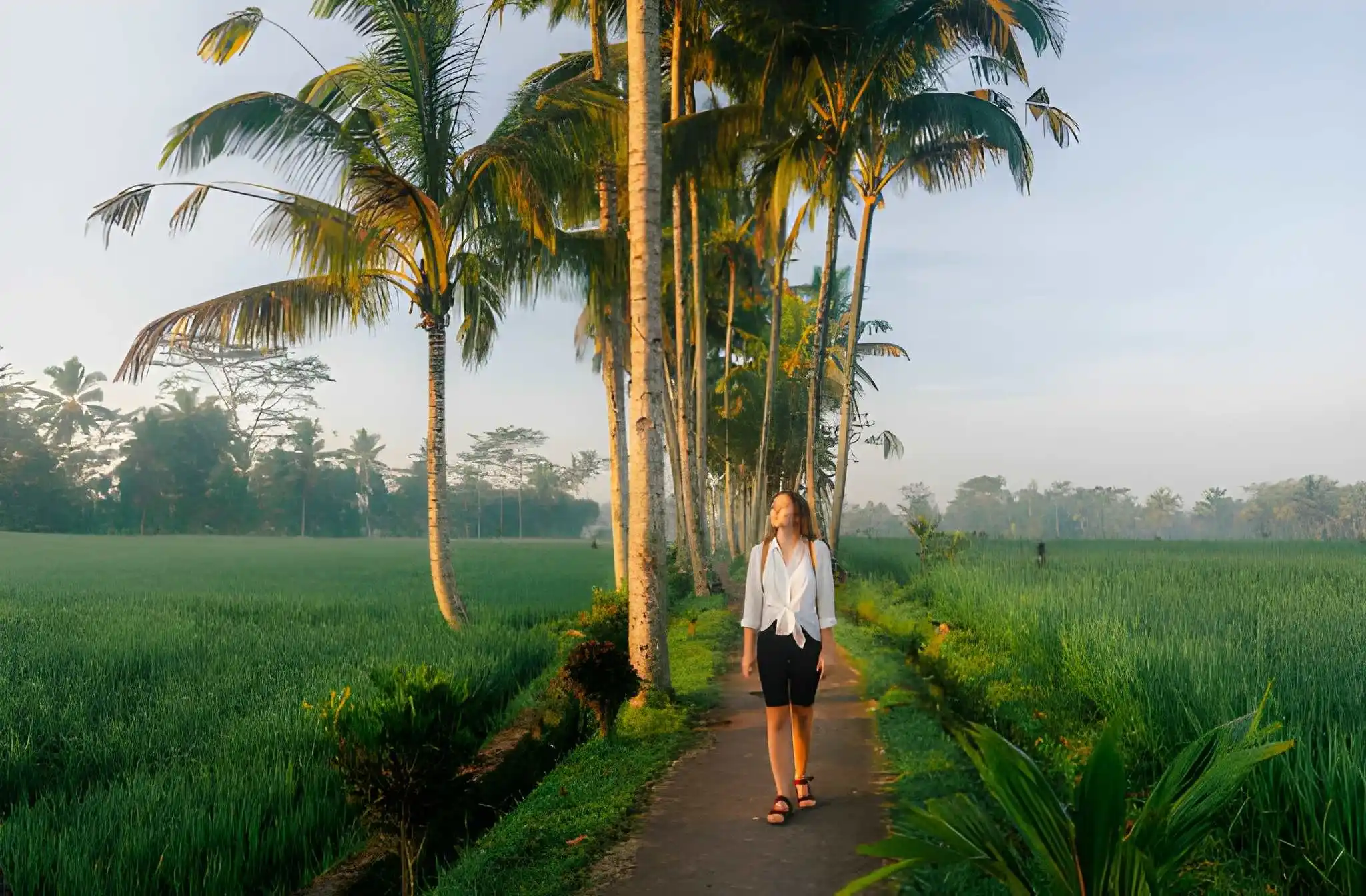
The rice fields around Sayan are not arranged for viewing. They exist as working landscapes, connected by narrow footpaths that link homes, temples, and irrigation channels. Unlike famous terraces built around dramatic slopes, these fields sit quietly between villages, changing gradually rather than impressively.
Walking here is about proximity, not scale. You are close to the fields, close to the water, and often close to the people working them. Irrigation channels run directly beside footpaths, and it is common to step aside as locals pass carrying tools or harvest bundles.
What makes these fields feel non touristy is how integrated they are into daily life:
- Paths are used for commuting, not sightseeing
- There are no designated photo spots or resting platforms
- Sounds come from water flow, insects, and distant voices rather than traffic
This kind of walk shows how Bali’s landscape functions when it is not framed as an attraction. The experience feels immersive precisely because it is ordinary.
3. Visit Taman Beji Griya Waterfall at a Quiet Hour
What you do: short waterfall visit with spiritual context
Where: Punggul, Badung
Taman Beji Griya is often introduced as a waterfall, but its role is closer to a purification site than a nature attraction. Stone carvings, water spouts, and temple elements shape the space, guiding how people move through it rather than inviting exploration.
When visited early in the day, the atmosphere feels calm and deliberate. Without crowds, the sound of water dominates, and the carvings feel less decorative and more functional. The site makes more sense when you move slowly, observing how water is directed through different levels and how space is divided for ritual use.
To experience it in a non touristy way, focus on:
- Visiting early, before group tours arrive
- Moving through the site gradually rather than stopping at each point
- Paying attention to how locals interact with the space
Approached this way, the waterfall feels purposeful. It becomes a place shaped by belief and routine, not performance.
4. Spend a Morning in Sidemen Village
What you do: village exploration and observation
Where: Sidemen Valley, East Bali
Sidemen works best in the morning, when the valley is active but unhurried. Roads are quiet, mist still lingers over the fields, and daily routines unfold naturally. There is no central attraction pulling people into one spot, which is why the village feels calm without feeling empty.
Walking through Sidemen is less about direction and more about presence. You move along small roads connecting houses, rice fields, and temples, often without knowing exactly where you will end up. The experience feels open ended, which is part of its appeal.
What defines a non touristy morning here:
- Villages function normally even as you pass through
- There is no expectation to stop, shop, or consume
- The landscape reveals itself gradually, not all at once
Sidemen suits travelers who are comfortable letting the place set the pace.
5. Watch Traditional Weaving in Sidemen
What you do: cultural observation
Where: local weaving houses in Sidemen
In Sidemen, weaving is part of household life rather than a scheduled demonstration. Looms are often set up inside or beside family homes, and the process continues regardless of whether anyone is watching.
Observing weaving here requires patience. Movements are repetitive and slow, and progress is measured over hours rather than minutes. This is not an experience designed to entertain, but to be witnessed quietly.
What makes this feel non touristy:
- Workshops are small and personal, not commercial
- Interaction happens naturally, without explanations unless asked
- The craft is presented as work, not spectacle
By simply observing, you gain insight into how tradition continues through routine rather than performance.
6. Walk Through Munduk Village
What you do: slow village exploration
Where: Munduk village center and surrounding lanes
Munduk is often introduced through its waterfalls, but the village itself tells a quieter and more complete story. The heart of Munduk sits along a narrow ridge road where houses, small shops, and gardens line both sides. Life moves slowly here, shaped by altitude and weather rather than tourism schedules.
Walking through the village feels unfiltered. Locals greet each other in passing, children walk home from school, and farmers move between coffee trees and clove plantations. The absence of large attractions makes the experience feel more genuine. You are not being guided from point to point. You are simply sharing space.
What makes Munduk village walks non touristy:
- Daily routines continue uninterrupted
- Cafes and guesthouses blend into residential spaces
- The pace is dictated by terrain and climate, not itinerary
Early morning is ideal, when mist still sits low and activity begins naturally.
7. Visit Munduk’s Clove and Coffee Plantations
What you do: informal plantation walk
Where: around Munduk and Gobleg villages
The plantations around Munduk are not arranged as tours. Paths weave between clove trees, coffee shrubs, and small processing areas. During harvest seasons, the air carries distinct scents, and work happens quietly across the slopes.
Walking these plantations offers context to Bali’s agricultural rhythm. You see drying racks beside homes and simple tools used for sorting and processing. The landscape feels productive rather than picturesque.
Key details that ground the experience:
- Plantations are part of village land, not separate attractions
- Harvest cycles shape daily schedules
- Work continues regardless of visitors
This is Bali experienced through its economy, not its aesthetics.
8. Explore Amed Beyond the Beachfront
What you do: coastal village walk
Where: Amed village backstreets
Amed’s main road runs along the coast, but the quieter side of the village sits just a few steps inland. Narrow lanes lead to family compounds, boat storage areas, and drying fish racks. The sea remains present, but not as a spectacle.
Walking inland reveals how closely daily life is tied to the ocean. Boats are repaired by hand, nets are laid out to dry, and conversations happen in shaded courtyards. The experience feels practical rather than curated.
Why this feels non touristy:
- Villages operate independently of tourism flow
- No defined walking route or highlights
- Daily work shapes the environment
Late afternoon works best, when fishing activity returns to shore.
9. Observe Traditional Salt Farming in East Bali
What you do: quiet observation
Where: Kusamba or Tejakula coastline
Salt farming along Bali’s east coast remains small scale and seasonal. Farmers use simple tools to collect seawater, evaporate it under the sun, and crystallize salt by hand. The process unfolds slowly and requires patience.
Observing salt farming is about understanding rhythm. There is no performance, no narration, and often no interaction unless you initiate it. The work speaks for itself through repetition and timing.
What defines the experience:
- Tools are minimal and functional
- Work depends entirely on weather
- Knowledge is passed through practice
This activity connects you to Bali’s coastal economy without turning it into an attraction.
10. Spend an Evening in Sanur’s Residential Areas
What you do: calm evening walk
Where: inland Sanur neighborhoods
Away from the beach path, Sanur becomes noticeably quieter at night. Residential streets fill with subtle activity. Families gather, offerings are placed, and the day winds down without spectacle.
Evening walks here feel reflective. There is no nightlife to chase and no landmarks to photograph. The experience is about observing how the day ends.
Why this feels non touristy:
- Streets serve residents first
- Evenings are communal rather than commercial
- Silence is part of the experience
Sanur shows how Bali slows naturally when not designed to entertain.
11. Sit by the Coast in Amed After Sunset
What you do: unstructured time by the sea
Where: Amed shoreline
After sunset, Amed’s shoreline quiets quickly. Boats rest on the sand, the water darkens, and conversations soften. There is nothing scheduled to happen, which is exactly why the moment works.
Spending time here is about presence rather than activity. You sit, watch, and listen. The coast feels expansive without feeling dramatic.
This experience works because:
- The absence of crowds changes perception
- Natural sounds replace activity noise
- Time feels open ended
It is a reminder that not every meaningful travel moment needs structure.
12. Join a Morning Market Routine in Gianyar
What you do: observe and blend into a local morning rhythm
Where: Gianyar traditional market area
Traditional markets in Gianyar operate early, often before sunrise. By the time many visitors wake up, transactions are already winding down. Walking through the market in the early morning places you inside a system that functions for residents, not visitors.
The experience is sensory but controlled. Vendors arrange produce with familiarity, conversations happen quickly, and movement follows unwritten rules. You are not expected to linger, photograph, or ask questions. You are expected to move with the flow.
What makes this experience non touristy:
- The market exists for daily supply, not browsing
- Time matters more than presentation
- Participation is passive and observational
Arriving early allows you to witness how Bali feeds itself before the day opens to visitors.
13. Observe Morning Temple Preparations in Village Temples
What you do: quiet observation
Where: small village temples across Gianyar and Bangli
Outside of major ceremonies, village temples are active in subtle ways. Early mornings are often spent cleaning courtyards, arranging offerings, and preparing spaces for later use. These moments are not announced or explained.
Standing nearby without interrupting reveals how ritual blends into routine. Movements are deliberate, practiced, and unhurried. There is no performance because there is no audience.
Key aspects that define the experience:
- Activities are practical, not symbolic for visitors
- Participation is not expected
- Respect comes from distance and stillness
These moments offer insight into spiritual life without entering ceremonial spaces.
14. Walk Along Irrigation Channels in Tabanan
What you do: slow walking and observation
Where: subak irrigation paths in Tabanan
The subak system is often discussed academically, but walking beside irrigation channels reveals its lived function. Paths follow water routes, linking fields, temples, and villages.
Walking here feels purposeful without direction. Farmers pass through regularly, checking water flow and field conditions. The environment is shaped by use rather than design.
Why this experience feels grounded:
- Water management is visible and constant
- Paths exist for function, not exploration
- Landscapes change subtly through seasons
This is Bali experienced through systems rather than sights.
15. Spend Time in a Village Bale Banjar
What you do: quiet presence in a communal space
Where: village community halls across Bali
The bale banjar functions as a social anchor. Meetings, preparations, and informal gatherings happen here, often without a fixed schedule. Sitting nearby allows you to observe how decisions and relationships unfold.
Nothing dramatic happens, which is precisely the point. Community life reveals itself through repetition and familiarity.
What defines the experience:
- Spaces are open but not performative
- Conversations are communal
- Time is flexible
You are witnessing structure rather than spectacle.
16. Visit a Local Home Workshop
What you do: observe household craft
Where: villages in Gianyar and Bangli
Small home workshops produce offerings, wood carvings, or daily use items. Work continues regardless of observation. Tools are basic, and processes are repetitive.
Observing these workshops emphasizes continuity. Skills are practiced daily, not preserved for display.
What makes this non touristy:
- Production is functional
- Interaction is minimal
- Work sets the pace
These moments connect craft to routine rather than heritage narratives.
If you are drawn to places that sit quietly beyond the usual routes, these experiences are only part of a wider layer of Bali that often goes unnoticed. You can explore more of these lesser known corners in our guide to Bali’s hidden gems.
So, Are Non Touristy Things to Do in Bali Still Possible?
Non touristy experiences in Bali are not about avoiding popular places entirely. They are about adjusting how you move through the island, when you go, and what you choose to pay attention to. Many of the moments that feel most meaningful happen in between destinations, during ordinary routines, and away from fixed schedules.
If you allow space in your itinerary, Bali reveals layers that do not announce themselves. Villages continue their rhythms, landscapes function quietly, and daily practices unfold without explanation. These experiences do not ask to be consumed. They ask to be noticed.
At Bali Island Vacations, we design travel guidance around this understanding. Not to chase hidden spots for the sake of being different, but to help you experience Bali in ways that feel balanced, respectful, and deeply grounded in how the island actually lives.
If you are planning your Bali journey and want it to feel unhurried, intentional, and connected to real places and rhythms, our guides are built to support that approach, quietly and thoughtfully.
For a wider perspective on traveling Bali beyond highlights and headlines, you can continue with our related travel guides below.
- Best Places to Visit in Bali for Your First Trip
- Best Time to Visit Bali Discover the Perfect Month for Your Island Vacation
- 15+ Bali Travel Tips for First Timers You Should Know
- 10+ Unique Cultural Experiences in Bali You Can Truly Feel
- Bali for Solo Travelers: Where You Feel Safe Connected and Free